
Lesson Progress
0% Complete

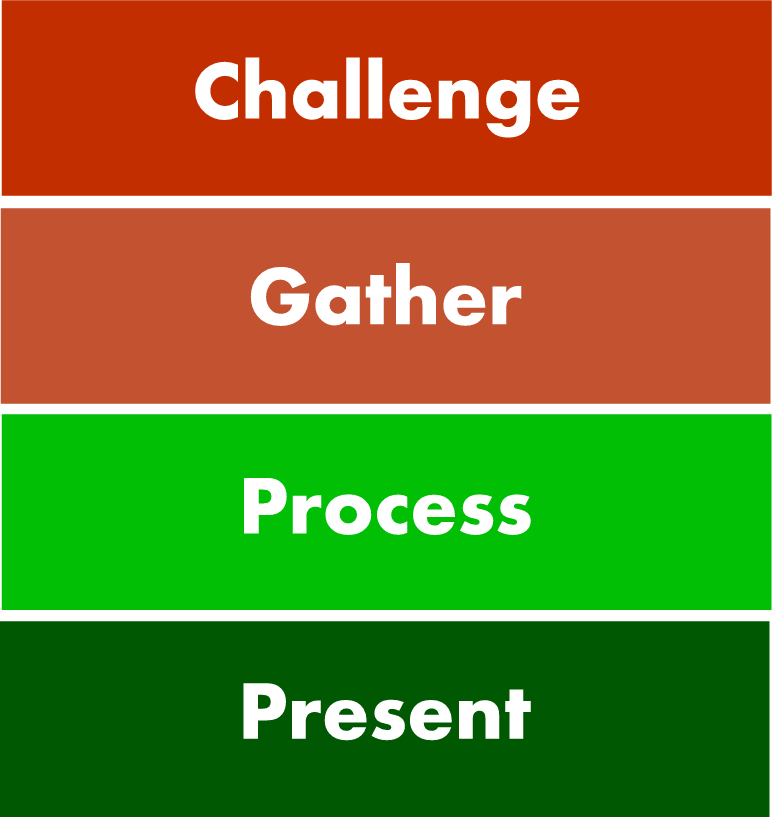
In their simplest form, all projects have four phases. The first phase sets the scenario and poses the challenge. The second phase involves gathering data and information. The third phase involves processing the information and data, and using higher-order thinking skills such as analysis, evaluation, synthesis etc. The final phase involves reporting.
| Phases | Scientific method (simplified) |
Problem solving (one cycle) |
Project process | WebQuests |
| 1 | Question – research -state hypothesis | Identify the problem | Problem / Question | Task (a real-world challenge) |
| 2 | Test with experiment | Develop alternatives | Gather data and/or information | Gathering resources (teacher preparation) |
| 3 | Analyse data and draw conclusions | Implement and evaluate | Process data and/or information | Processing information / deliberation |
| 4 | Communicate results | Draw conclusion | Present findings | Product and conclusion |
Table 1: Comparison of project processes
Familiarise yourself with two of these projects.. As you do so, note the four phases of the project. At which stage does each phase start?
Select ONE project from this list of project-based learning projects. Read the project description
- Healthy Eating (Gr 1-2)
- Teacher’s Pet (Gr 2-3)
- Food for Thought (Gr 6-8)
- Strictly for the Birds (Gr 10-12)
Select ONE project from this list of WebQuests. Read the WebQuest instructions.
- Are Professional Athletes Paid Too Much? (Gr 6-8)
- Tuskegee Tragedy (Gr 9-12)
- Slavery…Scars from the Past (Gr 6-8)
- How Will Our Garden Grow? (Gr 3-5)
