You are aware that technology infuses into our everyday life and certainly into the lives of our learners. Education institutions in developing countries are increasingly using online learning for the training of various professionals, and now with the COVID 19 pandemic, it has become important to improve educators’ capacity to effectively use digital tools and applications for both teaching and assessment. Educators in these institutions include teachers, trainee teachers, lecturers and tutors in universities and colleges. There are sustainable professional learning models, which are specifically designed to support educators for digital learning and these will positively impact your teaching and learning experiences. This course provides you with practical experience to help you integrate digital resources in your teaching.
NB: During this course our focus will be on using technology for your teaching and not the learners’ use of technology for learning.
About the course
In the face of massive educational needs, and considering the role that digital literacies and online learning can play in addressing those needs, this course aims to spark discussions and help educators plan for integrating technologies (online tools and resources) into their teaching and learning. We are going to challenge you to design a one well-planned lesson in which technology supports you and leaves you feeling elated afterwards. Application of different strategies for online facilitation is dispersed throughout the course.
Course outcomes
Once you have completed this course you should be able to:
- Explain how your practice aligns with the SAMR and TPACK models for technology integration;
- Develop an understanding of how the affordances of online tools can maximise learning;
- Design a learning activity that integrates technology resources to support your teaching;
- Be aware of guiding principles for designing assessment using appropriate online assessment tools that optimise learning;
- Evaluate learning activities that integrate technology to support teaching;
- Develop knowledge, skills and attitudes for online facilitation, with application of different strategies and tools.
Introduction to module
In Module 1 of this course we considered what it means to ‘be digital’. We looked at the range of different tools and technologies that can be used to interact with resources online. By online resources we mean people and content that are accessible through a range of tools and services available on the internet. Module 1 focused on developing digital identities. Module 2 focused on mobilising online resources.
In this module we will focus on interacting with people through online networks. This might be to communicate, share information or collaborate with others to take actions or produce content. This may be in a personal or community context, as part of learning activities or in relation to work and professional life.
In Module 1 on developing digital identities you were introduced to a range of situations where you might use ICT to access information or content that is available online. The kinds of resources that we identified included both people and digital media.
This Module is about making sure that you can find the digital resources you need and also about creating and sharing your own digital resources.
As digital technology becomes more common, affordable, and portable, more and more people from all parts of society are starting to increase their online and digital participation. Many newcomers to the online world may not know the full range of activities available online, or be bewildered by new and confusing communication platforms and conventions.
Understanding the new affordances, rules and potential pitfalls of the digital world doesn’t necessarily come automatically with long-term use. Not everyone using digital technology knows how to use the range of available tools to their best extent, and even experienced digital technology users can fall prey to hackers, lose control of how they are represented online, or otherwise fail to maintain their digital identities in an optimal manner. As such, there is a need for digital education leaders who can help improve, enhance or professionalise the ways in which their students, peers or family members use digital technology.
The following seven modules each focus on different aspects of online engagement, from a range of different perspectives. This module focuses on developing your digital identity or digital identities – the picture(s) of yourself that you create for the online world. It aims to help build your awareness and competencies of all the factors you’ll need to consider in conceptualising and creating your digital identity, alongside some of the tools and techniques to do so and examples of how others navigate this process. This will include topics such as access and equity, legal factors pertaining to online interactions, and how to stay safe online.
Welcome
Welcome to an exciting journey of personal and professional growth. We are so excited to learn with you and from you! It is natural to feel a bit nervous at the start but if you work together and support each other you will enjoy the voyage together. We would like to encourage you to use all the opportunities that will be coming your way. This Teacher Professional Development Course will be presented over 10 modules during which time you will be developing a toolbox of teaching, technology and 21st century skills. In each module you will be given the opportunity to learn more about an innovative teaching strategy, relevant assessment tools as well as some technology skills to assist you in applying what you have learned in your classroom.
As you develop new skills and can show how you use them in your classroom, you will be earning badges that are an acknowledgement of your determination to turn your classroom into a student-centred 21st Century learning space! So let’s get started…
This course proceeds or should be done concurrently with the “Planning for Technology Integration” course during which the initial planning for e-learning and technology in the school is completed. During this course we strategise around several key elements of change leadership, such as capacity building and the cultures of learning and evaluation, which will help to sustain the change and continue growing a sense of ownership of the e-learning vision. The course also addresses ongoing implementation issues regarding support and maintenance and facing challenges adaptively.
Why Change Leadership?
When new and innovative approaches are adopted in a school e-learning plan, new technologies may be identified as resources. Both represent change/transformation in the school. Implementing a School Technology Plan requires management of processes as well as people and technology. If process and technology are changing in a school, stakeholders (the people concerned) need to feel ownership of the direction of change if educational transformation is to succeed. Therefore, being a technology leader in the school requires an understanding of the process of change leadership, because ultimately it’s all about the people, especially the teachers and learners.
Learning Objectives
Participants who successfully complete the course will be able to:
- Describe how the traits of a visionary technology leader foster sustainable change in the school technology landscape;
- Drive the process of building a shared vision in the school;
- Describe the focus areas of the change process;
- Plan and implement a capacity building process;
- Develop a communication strategy to build a sense of ownership of the vision for e-learning in the school;
- Describe how to develop and exploit a culture of learning in the school;
- Describe a strategy for facing implementation challenges;
- Develop a culture of evaluation in the school;
- Evaluate the achievements and benefits of e-learning in the school.
This course simulates a process (stretching over two courses) which school leaders could follow while planning/reviewing and preparing for technology-enhanced learning in their schools. Previous courses in this CCTI programme have shown us how technology-based resources result in an ever-changing landscape which requires stakeholders to develop a clear vision and for leaders to facilitate the capacity-building of these stakeholders to respond collectively to that vision.
Planning is a cyclic process, as shown in the image below. We will follow one cycle during the process of the two courses in this series. We will follow a cycle similar to that shown in the image.
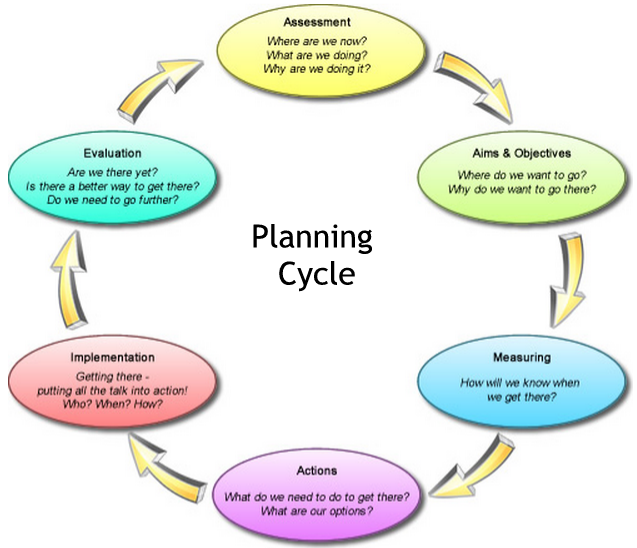
Source: Warren McCoullough, Innovative Schools, http://wazmac.com/ischools/planning/school-ict-planning/planning-cycle
This course, 8 Planning for Technology Integration, will follow the process starting with Assessment and going as far as Implementation in the Planning Cycle image. Course 9 Technology Leadership in Schools will cover the change leadership aspects of Implementation and culminate in the Evaluation stage.
Learning Objectives
Participants who successfully complete the course will be able to:
- Identify the constraints and advantages of their school’s context and the resulting potential to harness technology for learning;
- Analyse stakeholders and interact with each individual/group in a way that fosters ownership of the vision;
- Conduct planning for e-learning;
- Conduct technology planning;
- Write a professional learning strategy.
[youtube http://youtu.be/dFySmS9_y_0] Video: An Introduction to Project-based learning (3:34)
In earlier courses you learned about the key educational principles behind innovative approaches to learning and how digital literacy prepares students for a digital society. One way of bringing this approach to life in the classroom is through project-based approaches to learning. The purpose of this course is to provide participants with an understanding of the key components of a structured project and we will use the WebQuest as an example. The course is practical, exploring and analysing existing projects, and inviting participants to develop their own project using a 4-part structure. A planning template provides a “place” where the various ideas and aspects involved in a project design can be systematically collected. Where relevant, the concepts underlying the various aspects of a project are referenced and briefly explored.
Learning Objectives:
Once you successfully complete the course you will be able to:
- Analyse existing projects and recognise examples of sound principles, best practice and practical ideas for your own practice;
- Plan a WebQuest or similarly structured project;
- Plan a curriculum-aligned assessment strategy for a project;
- Evaluate the effectiveness of a WebQuest or similarly structured project;
- Select appropriate digital resources which are useful for teachers preparing and learners working on projects.
[youtube http://youtu.be/D6_U6jOKsG4]
Video:Re-Imagining Learning in the 21st Century (3:59)
The purpose of this course is to allow participants to take a deeper look at the wide variety of technology options available to today’s learners, and then to explore how to use these to create and manage innovative learning spaces. Participants will look at both traditional and new configurations and consider how they can use and manage these different technology options. Each raises unique issues to the teacher managing the class. These issues are related both to managing the class, and to designing the learning and the learning environment, no matter what options are available. In this course we will attempt to raise and discuss these issues so we can draw our own personal conclusions and be more effective designers of learning experiences.
Learning Objectives
Participants who successfully complete the course will be able to:
- Evaluate the potential to learning and teaching offered by different technology configurations;
- Describe learning experiences that exploit a specific technology’s advantages;
- Propose solutions to the management challenges of integrating technology in learning spaces;
- Review the opportunities and constraints of physical learning spaces;
- Articulate a vision for technology-rich learning spaces in the future.
Teachers require the competencies and knowledge to implement learner-centred classrooms that integrate technology and foster innovative teaching and learning practices. This course builds on the foundations of knowledge of learning theories and basic technology-enhanced teaching to focus on more innovative classroom activities. This course also focuses on learner engagement, developing 21st Century skills and engaging learners in knowledge-building tasks.
In his TED talk, Micheal Welsh introduces many of the ideas this course encompasses. He suggests we prepare youth to move from being just knowledgeable to knowledge-able; that is able to find, analyse, criticise information and create new knowledge. In order to embrace real-world problems our learners must know how to harness and leverage relevant tools. This will engage them in ways we often fail to do in today’s classroom.
[youtube http://youtu.be/LeaAHv4UTI8]
Video: Michael Wesch – From Knowledgeable to Knowledge-Able
Learning Objectives
Participants who successfully complete the module can:
- Express an opinion about the “digital native/digital immigrant” debate supported by evidence from the participant’s context and personal experiences;
- Critically examine how technology tools engage learners;
- Describe a typically innovative learning activity;
- Identify opportunities and challenges for using appropriate technologies to enhance innovation in learning activities;
- Design an innovative knowledge-building learning activity where the technology integration is focused on the learners;
- Design formative assessment strategies that can be used in innovative classrooms.
 Today’s learners can use a variety of technologies to access knowledge resources and interact globally with people. These interactions create a digital society that affords learners opportunities for education, entertainment and social interaction. Most of today’s children are comfortable using technology, but may not use it efficiently, effectively or appropriately. Teachers can create learning experiences that foster specific digital literacy skills. They can also help learners understand their roles and responsibilities as responsible digital citizens who can participate in the knowledge economy.
Learning Objectives
Participants who successfully complete the course will be able to:
- Explain the scope and impact of digital literacy.
- Evaluate pedagogical approaches that support the education of digital literacies.
- Teach advanced navigation and evaluation web resources.
- Create media to express an idea.
- Explain the principles of media literacy.
- Analyse media messages.
- Explain the responsibilities of digital citizenship.
- Develop a school plan for teaching digital literacy and digital citizenship.
Research demonstrates that teacher professional development is most effective when it is school-based and when teachers see it as directly relevant to teaching and learning. In the digital age, professional development activities have become de-centralised and individualised. At the same time they have become globalised and collaborative. In this course, you will select a focus for your own professional development and experience the variety of resources and tools available.
You will develop recommendations for leading professional development at your school. This course builds foundational knowledge and technology skills useful for participating in the CCTI programme and for planning a school-wide professional development strategy in Course 8: Planning for Technology Integration.
Learning Objectives
If you successfully complete the course you should be able to:
- Select a professional growth goal and reflect on the efficacy of the available professional development resources pertaining to your goal.
- Collect, curate and share relevant online resources in support of a professional growth goal.
- Participate in a professional learning community/network relevant to your goal.
- Use technology tools/demonstrate technology skills in support of professional development.
- Relate your professional development experience in the course to the professional development needs at your workplace.
Preparation

You will require Adobe Reader to read the PDF format of the course documents. Click on the icon to download the latest version of Adobe Reader.
The purpose of this course is to inspire you to explore the possibilities of teaching in innovative, educationally sound ways. It is a foundational course which can provide an impetus for a more detailed exploration of various aspects of innovative teaching and learning, both in terms of your own practice (as a stand-alone), but also specifically as a basis for the other courses. You will critically evaluate some current innovative approaches which are broadly constructivist in approach. By becoming familiar with some key concepts and some principles of instructional design, you will understand the need to adopt and foster a constructivist approach. You will be introduced to the habit of reflecting on your own practice, and also to discussion and collaboration within the group studying the module, thereby setting up those skills for future modules.
What is instructional design?
In this video, Dr Mark Bullen from the Commonwealth of Learning, provides an overview of the field of Instructional Design.
[vimeo http://vimeo.com/97171390]
Video: What is Instructional Design? (5 min)
Learning Objectives
Once you have successfully completed this course you will be able to:
- understand and apply some basic theoretical concepts and instructional design principles.
- justify adopting a constructivist approach where you feel it is appropriate in your teaching.
- approach your teaching in an innovative manner.
- recognise the importance of being a reflective practitioner and have a personal blog to journal these reflections.
- work in a collaborative manner with fellow-teachers.
- analyse examples of good practice and draw out applicable principles and practical ideas for your own practice.
- be familiar with and be able to use a set of useful online tools for thinking and for sharing ideas.
Your Blog
During this course, you will keep a blog. This blog will function as a portfolio for the course, and will, when taken as a whole, be the basis on which this course is assessed.
But it is also much more than a mere e-portfolio. It is intended that this blog will initiate an ongoing willingness to share ideas and resources, to reflect on success and failure, to contribute to the educational world beyond the walls of your own classroom and school.