

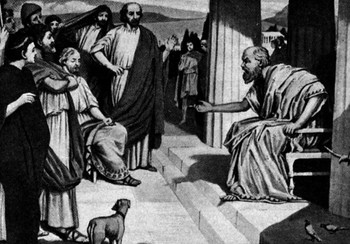
1: Socrates and the invention of writing
Writing is one of humanity’s greatest inventions, and yet Socrates, who is one of the greatest of humanity’s thinkers and teachers, was opposed to it. To find out why, explore some or all of the following resources.
Video: Author Maryanne Wolf on the invention of writing (14:22). Watch this clip from 7:40.
In this next clip, Maryanne Wolf talks about the death of rhetoric: http://www.c-span.org/video/?c4388888/socrates-rhetoric
Here is an article by her from the New York Times: Socrates’ nightmare by Maryanne Wolf
- This quote from the article sums up her argument:
At the core of Socrates’ arguments lay his concerns for the young. He believed that the seeming permanence of the printed word would delude them into thinking they had accessed the heart of knowledge, rather than simply decoded it. To Socrates, only the arduous process of probing, analyzing and ultimately internalizing knowledge would enable the young to develop a lifelong approach to thinking that would lead them ultimately to wisdom, virtue and ‘friendship with [their] god.’
To Socrates, only the examined word and the “examined life” were worth pursuing, and literacy short-circuited both.
Source: New York Times: http://www.nytimes.com/2007/09/06/opinion/06iht-edwolf.4.7405396.html
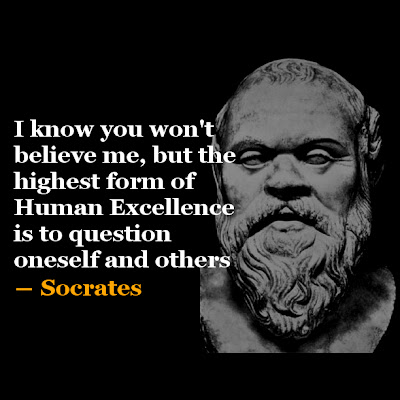
For more Socrates quotes: http://www.pinterest.com/maryalicehurst/socrates-quotes/
For more on Socrates: http://en.wikipedia.org/wiki/Socrates
2: Read this article by Nicholas Carr: Is Google Making us Stupid? He makes a similar argument to Socrates’ argument about writing, i.e., that new technologies are reducing our ability to think deeply and truly “examine life”.
- What do you think?
- Can technology be used in ways that promote rather than undermine thinking?
- Write a paragraph with your ideas, and submit it to the course discussion page.
You can also refer to this article which argues that technology is seriously affecting our thinking:
http://www.creativitypost.com/technology/how_technology_is_warping_your_memory
3: Study this infographic which sets out the six steps of Socratic questioning:
http://ticsyformacion.com/2012/03/24/el-proceso-socratico-infografia-infographic-education/
- Make notes about the Socratic approach in your note-making app.
- Note particularly why this is important, and how you might go about it.
4: Try this out:
On your next school day, in your teaching, try to be as Socratic as possible. If you can, try to present everything you say to your students in the form of a question.
-
 Return to the discussion group called 2.5 So Many Questions and discuss with your group what this was like. Was it difficult or not? What made it difficult/easy?
This article can give you some good ideas on how to go about being more Socratic in your teaching: http://www.criticalthinking.org/pages/the-role-of-socratic-questioning-in-thinking-teaching-learning/522
Virtual field trip
While it is possible, although difficult, to run a Socratic classroom, it is very difficult to run a whole school based on principles of questioning and inquiry. To see an example of such a school, listen to Chris Lehmann talking about the Science Leadership Academy [SLA] (16:55)
You can visit the school’s website here: http://www.scienceleadership.org/
Answer these questions in the ongoing discussion for this lesson:
- In what ways does SLA put into practice Constructivist principles?
- In what ways does SLA put into practice Socratic principles?
If you enjoyed his talk, here is another TED talk by Chris (21:30):
https://www.youtube.com/watch?v=6FEMCyHYTyQ
When you are ready to continue to the next activity, click on the Mark Complete button below (first time) and Next Topic on subsequent visits to this page.
